

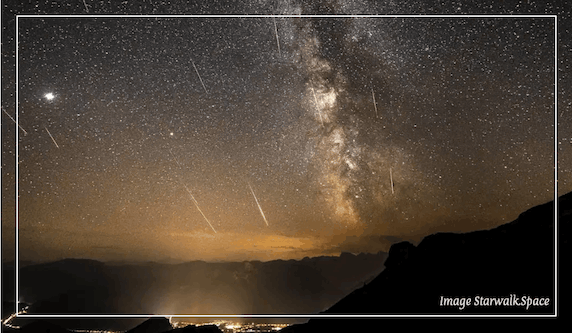
Leonids meteor shower and random acts of kindness
I woke up at almost 2:00 PM today but I have a good excuse for that. Leonids meteor shower.
From 2:00 to 4:00 AM, hubby and I were lying down on borrowed cardboard and rubber mats (big thanks to students and fellow astronomy fans out there!), at the view deck of the PAGASA Observatory in UP Diliman Campus. It became quite cold at around 3:00 AM and that’s when we realized how stupid we were for not bringing anything, not even a jacket! 🙂 Next time, we know better!
Anyway, the long wait was definitely worth it. We started seeing meteors every 15 or 30 minutes or so. If my estimate is correct, I have seen about 11 of them. Not bad for a 2-hour stay. The lady (from the group beside us) who started their watch at about 9:00 PM said she was already on her 25th meteor by the time we were leaving. Therefore, using a simple calculation, she have seen an average of 3 to 4 hours meteor an hour. Not bad too! [Whoever you are, we want to thank you and your friends again for kindly sharing your mats with me and hubby–who are total strangers in the dark! This post is also for you and how much you reminded us of the power of random acts of kindness.]
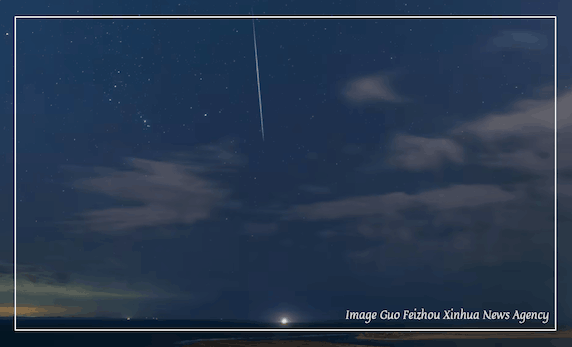
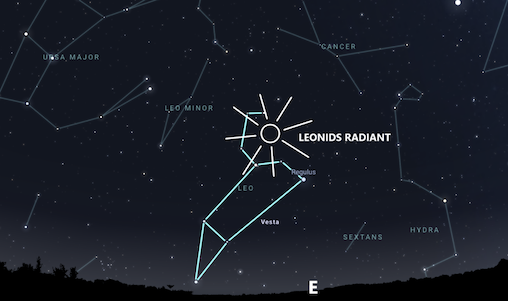
The Leonids originate from the debris left by Comet 55P/Tempel-Tuttle, which is a short period comet that orbits the Sun once every 33.8 years [Ford, 2019]. What we see as “falling” stars are the comet’s debris while they intersect Earth’s orbit. The Leonids, which appear to radiate from the constellation Leo, are one of the most awaited meteor showers as they have a rich history, with historical notes revealing episodes of significant “meteor storms.” The first storm was estimated to have occurred in November 1833. It was said to have lasted for about nine hours (!) and could have produced an estimated rate of more 72,000 meteors an hour at the storm’s peak (Astronomy Trek, n.d.). [2]
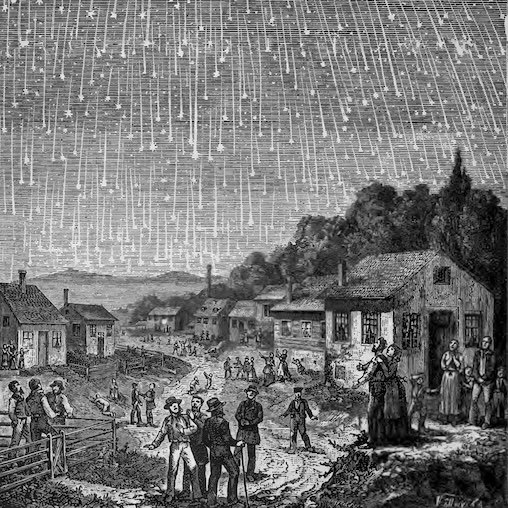
Other accounts indicated an estimate of about 240,000 meteors over the nine-hour episode (French, M. & Snyder, D.,1998, 1999). [3] An online search returned an illustration of the 1833 storm, which is said to be engraved by Adolf Vollmy in 1889. An even brighter peak of roughly 150,000 per hour was observed in the 1966 meteor storm. [3]
I am amazed not only by the quality of the art work by Vollmy but also by the intensity of such a meteor shower! I am sharing personal accounts below. [4]
Image (Right): This 1833 Leonid meteor storm was produced in 1889 for the Adventist book, Bible Readings for the Home Circle. The engraving is by Adolf Vollmy based on an original painting by the Swiss artist Karl Jauslin. Historical notes indicate that Jauslin created the painting based on a first-person account of the 1833 storm by Joseph Harvey Waggoner, a minister who encountered the storm on his way from Florida to New Orleans. [5]
Personal accounts on the 1833 Leonid Meteor Shower
“…November 13. About 4 o’clock a.m. I was awakened by Brother Davis knocking at my door, and calling me to arise and behold the signs in the heavens. I arose, and to my great joy, beheld the stars fall from heaven like a shower of hail stones; a literal fulfillment of the word of God as recorded in the holy scriptures as a sure sign that the coming of Christ is close at hand. In the midst of this shower of fire, I was led to exclaim, how marvelous are thy works O Lord!” – Prophet Joseph Smith [4]
“The morning of Nov. 13, 1833, was rendered memorable by an exhibition of the phenomenon called shooting stars, which was probably more extensive and magnificent than any similar one hitherto recorded…. Probably no celestial phenomenon has ever occurred in this country, since its first settlement, which was viewed with so much admiration and delight by one class of spectators, or with so much astonishment and fear by another class. For some time after the occurrence, the ‘meteoric phenomenon’ was the principal topic of conversation in every circle.” [6]
I have only seen about 11 meteors that evening and I felt a certain high already. What more if I experienced such a storm of meteors?! My favorite meteor happened sometime around 3:30 AM–it left a bluish streak of light and the ‘train’ it created was thicker than the others I have seen this morning. It appeared on the right of the Leo Minor star constellation (at least from my vantage point of view). I shouted and clapped my hands along with the others who would also normally applause and cheer every time a meteor arrives. Wow, if we had seen one meteor only that night, then it would already be worth the long and chilly wait.
The other meteors were equally magical, leaving reddish, yellowish and mostly whitish glow along the dark skies. One even had an almost greenish tinge! According to the NASA website, “The color of many Leonids is caused by light emitted from metal atoms from the meteoroid (blue, green, and yellow) and light emitted by atoms and molecules of the air (red). The metal atoms emit light much like in our sodium discharge lamps: sodium (Na) atoms give an orange-yellow light, iron (Fe) atoms a yellow light, magnesium (Mg) a blue green light, ionized Calcium (Ca+) atoms may add a violet hue, while molecules of atmospheric nitrogen (N2) and oxygen atoms (o) give a red light. The meteor color depends on whether the metal atom emissions or the air plasma emissions dominate.”
This is where you can see Leonids every November. [Image by Fox13Now.com]
The news articles about the recent meteor showers predicted that there would be about 100 meteors appearing every hour but unfortunately, I think the visible ones numbered about five per hour only. I guess one reason is that the others were not visible to the naked eye anymore because of the clouds and yes, the level of pollution in Manila. I always think that ‘stars shine more brightly’ in the provinces because the air there is cleaner and therefore the skies are clearer. It makes sense because according to scientists, those ‘hazy’ skies are mostly caused by air pollution. One probable factor why we also didn’t see more meteors was the cumulative effect of city lights–I am very sure that we’d see more of the meteors had we been watching from, say, a secluded beach resort or a mountaintop. I hope we city dwellers will do something more concrete to combat air pollution, or we are doomed to a future with no more nights of stargazing and meteors-watching.
It was my first time to do stargazing again after a long while. This time, I have a husband beside me (who must have been thinking how the heck did he end up with a wife who would force him outside the house at such unholy hours just to watch falling stars…lol). [Yes, hubby, expect more of nights and early mornings like that!]
I posted this in Facebook today, “Looking at the expanse of the night skies with stars scattered all over like burning jewels, it made me think again about how mysterious, beautiful, perfect and energizing the universe is. Everything is just so perfect–the planets don’t colide, the earth just circles the sun in harmony with all the other planets, and we live, we breathe, we laugh…Ahhh, this is so full of mystery, so full of magic…”
God-source-divine must really really love us all very much.
For more details about Leonid meteors and other astronomical stories, you may visit High Point Scientific and the references listed below.
References
[1] Ford, D. [ed] (2019). Leonid meteor shower 2019. In the Sky. Available at https://in-the-sky.org/news.php?id=20191118_10_100
[2] Miller, J. (n.d.) The Great Leonids Meteor Storm of 1833. AstronomyTrek. Available at https://www.astronomytrek.com/the-great-leonids-meteor-storm-of-1833/
[3] French, M. & Snyder, D. (1998, 1999). The Leonids (Selected Text From Various Web Sites). Reflections. Available at
https://websites.umich.edu/~lowbrows/reflections/1998/mfrench.1.html
[4] Joseph Smith Foundation. (n.d.) Meteor Shower of 1833 – Accounts. Joseph Smith Foundation. Available at https://josephsmithfoundation.org/meteor-shower-of-1833/
[5] Constellation Guide. (2014, Nov 15). Leonids. Constellation Guide. Available at https://www.constellation-guide.com/leonids/
[6] Denison Olmsted, “Observations on the Meteors of November 13th, 1833,” The American Journal of Science and Arts, 25 ([Jan.?] 1834, Volume XXV, 363, 365, 366, 386, 393, 394. [As cited in Joseph Smith Foundation]
Note: Several parts here had been updated /edited so some of the references are more recent.
Image credits: Featured image of Leonids Meteor by StarwalkSpace; Guo Feizhou; Adolf Vollmy (via the Adventist book, Bible Readings for the Home Circle); and Fox13Now.
Mama Earth loves you: To maintain independence, this website is self-funded and this write-up is not a commissioned work. There is no request for donation but if you can plant a tree (or two!) on your birthdays, it will really be awesome and will make Mama Earth very happy! P.s. It’s better if you could join the You’ve Got TREE-mail! Chain.
Leave a Reply