

Saving the iconic panciteria in Rizal’s Fili—and the rebirthing of courage, the rediscovery of who we are
Let me tell you a story about the iconic panciteria [1] in Dr. Jose Rizal’s El Filibusterismo.
I chanced upon it back in 2023 through a social media post [2]. It’s one of those things that one should not simply let go of–the deteriorating condition of the building needs an urgent intervention. Through a legislator (whose work I support), efforts had been done to reach out to the National Historical Commission of the Philippines (NHCP). This is a historically important building in Binondo, which used to house the Panciteria Macanista de Buen Gusto. An online search will tell you that this panciteria was mentioned in Chapter 25 of the second novel of our highly esteemed national hero. (Do consider reading a passage from the chapter, which is is shared below.)
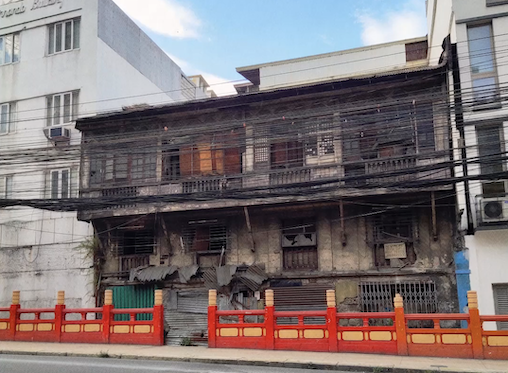
Based on the same social media post, a Cease & Desist Order against its planned demolition was issued, apparently by or through the City of Manila. This was made possible by the efforts of an unnamed barangay kagawad. (Whoever you are po, I am sending my heartfelt thanks for doing this for our national hero and the Filipino people.) The image on the left below shows the current condition of the building while the one on the right is an archived photo of that section of Binondo where the panciteria is located (dated 1899). In the old image, the panciteria is the building at the center of the image, just a stone’s throw away from the Binondo Church. [Images used in this post are credited to Jake Zaragoza (below, left); John Tewell courtesy of US Library of Congress (below, right); and Stephen Pamorada (featured/banner image)].
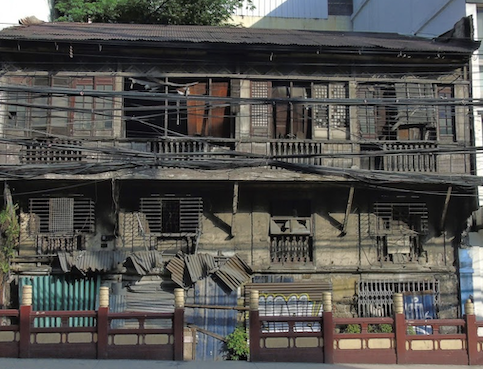
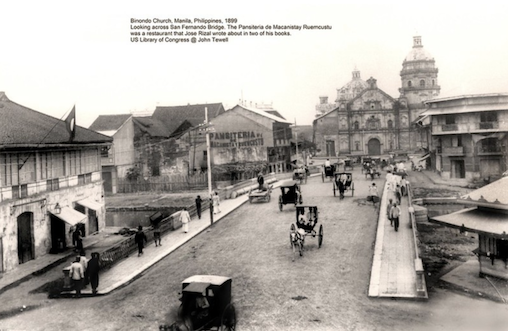
Images (left): Jake Zaragoza; (right) John Tewell; (top, feature /banner) Stephen Pamorada.
Online accounts and articles mention that the property is owned by a certain “Don Severino Alberto” though there seems to be an uncertainty on current ownership. (This is briefly discussed in the NHCP letter, a portion of which is shared in this piece.) As per NHCP, this structure, located in Barangay 287, is a presumed Important Cultural Property (ICP) and a registered local cultural property of the City of Manila, as listed in the National Commission for Culture and the Arts’ (NCCA) Philippine Registry of Heritage (or TALAPAMANA).
That same year, through the first legislator, we wrote to the NHCP (Oct 2023) to request for more information, mentioning two possible laws that might help in protecting and saving the building: the [i] National Cultural Heritage Act (RA 10066) and [ii] Strengthening People’s Nationalism through Philippine History Act (RA 10086). Based on RA 10066, the building may qualify as Historical/Cultural Property or Cultural Property Considered Important Cultural Property (or an appropriate designation). I have read that the building is likely more than 140 years, well surpassing the minimum age of 50 years, which is the requirement for the designation of historic structures [Sec. 5 (f) of RA 10066].
In our 2023 letter, we appealed for the NHCP’s support in ensuring that this important building will be protected, restored, and preserved. We also requested for the “designation and status of this building (including legal ownership), funding necessary for intervention measures (e.g., conservation, restoration, etc.), and other steps that the government can do to ensure that it will be protected and accorded the appropriate measures in accordance with existing laws and regulations.” We are grateful that NHCP replied to us.
I’m copying-and-pasting a portion of NHCP’s reply (dated 20 Dec 2023) here, to wit:
“We sincerely appreciate your commitment to this endeavor. Below are our detailed responses to each of your specific questions:
[1] Cultural Property Status: The Panciteria Macanista de Buen Gusto is a presumed Important Cultural Property (ICP) and is listed as a cultural property of the City of Manila. This status grants it legal protection against unauthorized modifications or demolition.
[2] Declaration by the National Government: For the property to be officially declared a heritage site by the national government, the consent of its private owner is required. However, details about the current ownership remain unavailable.
[3] Funding for Restoration: Restoration funding can only be secured once the property is recognized at the national level by agencies such as the NHCP or NCCA. This recognition serves as a basis for justifying the allocation of funds for restoration projects.
[4] Structural Assessment and Studies: After the declaration and funding are secured, a comprehensive structural assessment must be conducted. This step is essential before undertaking Detailed Engineering Studies (DES), ensuring compliance with the Procurement Law.
Given the above considerations, we express our full support for any initiative aimed at the property’s preservation, including restoration and potential adaptive reuse. While a detailed analysis is still required, the current dilapidated state of the structure undeniably calls for immediate
intervention.“
—end of quoted text from the NHCP letter—
We are thankful for said updates and information from NHCP. We then sent a reply (via email dated 7 Jan 2025) to the December 2023 response of NHCP, where we requested for further information, specifically on item no. 2 (details on current ownership being “unavailable”).
We requested to know if NHCP–after receiving our 6 Oct 2023 letter–has already undertaken efforts to ascertain the ownership. As indicated in item no. 1, the said property is listed as a cultural property of the City of Manila, therefore, we assumed that the LGU of Manila will be able to help identify the owner/s of the property.
We also asked if efforts were undertaken to reach out to the Court of Manila and/or Barangay 287 assuming that the Cease & Desist Order against its planned demolition could already serve as a good lead. Unfortunately, we have not received a reply from NHCP anymore. [UPDATE as of 3 Jul 2026: Not ready to give up on it, we again wrote to NHCP recently as a follow-up to our 7 Jan 2025 email (this time through another legislator, the son of the previous one, as the latter decided not to run for another term). We hope to hear from them soon.]
We are really exerting efforts on this because of the state of the building already. I am not too sure how long can the integrity of the structure and the mostly wooden materials of 3rd level can last. I could not see any available document online about its plans /design but I surmise that the first two storeys are made of stone /concrete as was the architectural practice during the Spanish colonial era. The concept of bahay na bato (stone house or house made of stone) is, of course, an evolution from the bahay kubo, which is our indigenous approach to home design, shaped by our tropical climate and the abundance of natural materials. [3a, 3b]
I am very concerned because we are in the typhoon belt and in recent years, we’ve been experiencing stronger typhoons. (I am thankful though that this part of Manila is seemingly being shielded from strong typhoons and perhaps the spirit of our beloved Rizal is still protecting the building!)
My professional concentration is focused mostly on environment, social, and governance (ESG) and for the past several years, I am also exerting efforts to expand my knowledge and experience in heritage protection and conservation. ESG professionals should also explore more opportunities in contributing to public policy and heritage protection and conservation. Both physical environment and cultural assets require analytical tools and perspectives that the ESG discipline can provide. As we do our best to contribute and learn more in ESG, conservation work, and policy making, let’s keep on pushing the envelope further. As I would sometimes mention to my principals, “we pass this road only once.”
I am also thankful that there are many online courses available now, allowing professionals to continue learning while thriving in their careers. Incidentally, I have completed the diploma course, Architectural Conservation and Historic Preservation, delivered by the Indian Institute of Technology Kharagpur and the National Programme on Technology Enhanced Learning [NPTEL]. It is being made available online via Alison. [I am not in any way related to Alison but, through this post, I am sending them my heartfelt appreciation.]
I will update this post as soon as we hear from NHCP again. In the meantime, I discovered recently that there is a petition for the panciteria. It will be great if you can sign the petition via this link.
As I close this piece, I reflect on the steps that we all could do to protect, save, conserve, and restore our heritage and historical assets. It is not really about romanticizing the past (though it helps somehow). For me, by taking concrete action to protect what our heroes left for us (their legacy), we are also rebirthing courage—borne from the past where it was too difficult to be brave. Rizal was martyred at 35. He faced death not as a punishment but as a worthy sacrifice so we may be awakened.
I think this supreme act alone—and the way we can honor his story—is also a rediscovery of who we are as a nation.
Shared below is a passage from Chapter 25 of El Filibusterismo. Big thanks to the Project Gutenberg library for the online version of the second novel of Dr. Rizal. [4]
Excerpts from Chapter 25 (“Smiles and Tears”) of Jose Rizal’s El Filibusterismo
“The sala of the Panciteria Macanista del Buen Gusto that night presented an extraordinary aspect.
Fourteen young men of the principal islands of the archipelago, from the pure Indian [5] (if there be pure ones) to the Peninsular Spaniard, were met to hold the banquet advised by Padre Irene in view of the happy solution of the affair about instruction in Castilian. They had engaged all the tables for themselves, ordered the lights to be increased, and had posted on the wall beside the landscapes and Chinese kakemonos this strange versicle:
“GLORY TO CUSTODIO FOR HIS CLEVERNESS AND PANSIT ON EARTH TO THE YOUTHS OF GOOD WILL.”
In a country where everything grotesque is covered with a mantle of seriousness, where many rise by the force of wind and hot air, in a country where the deeply serious and sincere may do damage on issuing from the heart and may cause trouble, probably this was the best way to celebrate the ingenious inspiration of the illustrious Don Custodio. The mocked replied to the mockery with a laugh, to the governmental joke with a plate of pansit, and yet—!
They laughed and jested, but it could be seen that the merriment was forced. The laughter had a certain nervous ring, eyes flashed, and in more than one of these a tear glistened. Nevertheless, these young men were cruel, they were unreasonable! It was not the first time that their most beautiful ideas had been so treated, that their hopes had been defrauded with big words and small actions: before this Don Custodio there had been many, very many others.
In the center of the room under the red lanterns were placed four round tables, systematically arranged to form a square. Little wooden stools, equally round, served as seats. In the middle of each table, according to the practise of the establishment, were arranged four small colored plates with four pies on each one and four cups of tea, with the accompanying dishes, all of red porcelain. Before each seat was a bottle and two glittering wine-glasses.
Sandoval was curious and gazed about scrutinizing everything, tasting the food, examining the pictures, reading the bill of fare. The others conversed on the topics of the day: about the French actresses, about the mysterious illness of Simoun, who, according to some, had been found wounded in the street, while others averred that he had attempted to commit suicide. As was natural, all lost themselves in conjectures. Tadeo gave his particular version, which according to him came from a reliable source: Simoun had been assaulted by some unknown person in the old Plaza Vivac, the motive being revenge, in proof of which was the fact that Simoun himself refused to make the least explanation. From this they proceeded to talk of mysterious revenges, and naturally of monkish pranks, each one relating the exploits of the curate of his town.”
Notes and references
[1] A panciteria is a type of restaurant in the Philippines that specializes in serving Filipino-Chinese dishes, particularly various kinds of pancit, which are stir-fried noodle dishes. (Source: Dictai.org)
[2] Social media post by a certain Mr. Edison Molanida and shared by Atty. Trixie Cruz-Angeles and Ahmed Paglinawan. (2023, Oct 4). Available at https://m.facebook.com/story.php?story_fbid=pfbid0RnsdBz7vg9uv6Wc6AuDFmtgBkFps5TAAMRsFXkBd46JLpboipRo4YedaAhXfJ2K9l&id=100044205260834&mibextid=Nif5oz
[3a] Rialp, C. (2024). Bahay na Bato Architecture: 10 Amazing Homes. https://bluprint-onemega.com/architecture/heritage/modern-bahay-na-bato-architecture-300-years-in-the-making/
[3b] Arguson, S. E. (2021). Tahanang Bayan: The Bahay na Bato as Filipino. Center for Intramuros Studies.
https://intramuros.gov.ph/2021/08/31/tahanang-bayan-the-bahay-na-bato-as-filipino/
[4] Rizal, J. (1912). El Filibusterismo (The Reign of Greed), A Complete English Version of El Filibusterismo from the Spanish Version (C. Derbyshire, Trans). Philippine Education Company, in Gutenberg Project. (Original work published 1891.)
https://www.gutenberg.org/files/10676/10676-h/10676-h.htm#d0e4839
[5] I am not too sure if this word (“Indian”) is a case of being “lost in translation.” I am guessing that the original term was Indio, which is the term used to describe Filipinos during the Spanish colonial period. “Far from a simple geographical descriptor, ‘Indio’ became the default, often pejorative, label applied by the Spanish colonial administration and ruling elite to the native inhabitants of the archipelago…The appellation “Indio” originated from the mistaken belief of European explorers, including Christopher Columbus, that they had reached the East Indies when they arrived in the Americas. Consequently, the native populations of the Americas were labeled “Indians.” This misnomer was later extended to the native inhabitants of other lands colonized by Spain, including the Philippines, which was claimed for the Spanish Crown by Ferdinand Magellan in 1521 and effectively colonized starting with Miguel López de Legazpi’s arrival in 1565.” (Source: Sinaunang Panahon, available at https://sinaunangpanahon.com/the-plight-of-philippine-indios/)
Mama Earth loves you: To maintain independence, this website is self-funded and this write-up is not a commissioned work. There is no request for donation but if you can plant a tree (or two!) on your birthdays, it will really be awesome and will make Mama Earth very happy! P.s. It’s better if you could join the You’ve Got TREE-mail! Chain.

Leave a Reply