


[Part 2] Will Tino’s floods finally push us into action?
Second of Two Parts
[Conceptual image above created through Perchance.]
SILENCE is complicity. Our children deserve the best of us–and the best of us could only come from courage. It is important that we continue calling out systemic failures, negligence, and corruption. We cannot and must not abandon our and our children’s future in the hands of those who prefer and ensure our silence.
AS we call for accountability, we also need to participate in the design and implementation of solutions. At the end of the day, we are the government. We are the ones who elect leaders into power. Isn’t it true that we deserve the government that we voted for? We are from the same vessel. What we see now are also borne from our own decisions. It is, therefore, important to focus on solutions while ensuring and demanding accountability (and voting for trustworthy leaders next time).
IT is not as if the world has run out of solutions. Solutions have always been there and will continue to be designed, tested, implemented at scale and iterated. This article does not cover all solutions and best practices but this attempts to contextualize the solutions in the Philippine settings particularly through local government units (LGUs), private sector, the CSOs, and academic community. Naturally, the national government is part of the solutions but the role of LGUs is more critical than ever–it is through them that national programs particularly those for the environment, fisheries, agriculture, and related sectors are implemented in the community and household level. These solutions must be implemented as we read this (or their implementation be strengthened if they are already in place).
[1] TREE planting. The Philippines has an existing law that mandates all Filipinos to plant trees, beginning at 12 years old. This is the Arbor Day Act of 2012 (RA 10176). However, it is not being strictly implemented, or more precisely, in the manner and scale as provided by the law. This is unfortunate because based on studies, trees in urban areas can intercept 50–60% of rainfall [1] [2]. The law also mandates all LGUs to declare an Arbor Day or Tree Planting Day, which “shall be declared as a public working holiday in order to ensure the participation of the different sectors of society…” Meanwhile, its IRR specifically provides the role of barangays in maintenance, to wit, “(a) Maintenance — The barangay which covers the planting site and a deputized non-governmental organization shall be responsible for the maintenance of trees. The province, city or municipality may also designate caretakers in the said area in coordination with the concerned barangay (Section 6, IRR)” [3].
CLEARLY, the Philippines already has the enabling law for massive tree-planting. What could be necessary is for the citizenry to push their LGUs more actively and help ensure that the trees are nurtured and monitored. If you could read this, I hope you can write to your LGUs (from the barangay to the provincial levels) and request for its strict implementation. I will write to or request a legislator to write to DENR, Bureau of Plant and Industry (BPI), and DILG but if you can do the same, it will also be helpful. Note that BPI is the agency mandated by RA 10176 to provide the seeds/seedlings (Section 7). Meanwhile, DENR is tasked to provide technical assistance to the LGUs, to wit, “(c) Department of Environment and Natural Resources (DENR) c.1 Technical assistance in the preparation of the LGU Greening Plan; establishment of nursery and in seedling production; and site identification, characterization and preparation. (Section 1, IRR).”
ANOTHER area that needs attention is in the participation of the private sector, academic community, CSOs, media, and the general public. Naturally, the government cannot do it alone. The engagement of the private sector (including all of us) is critical. Businesses may be motivated by offering incentives (e.g., tax credits, use of green priority lanes in business permitting, awards/recognition, etc.). Schools could also incorporate tree-planting as requirements in selected courses and/or graduation. Incidentally, bills requiring it for graduation in senior high school and college have been passed on third and final reading at the Lower House in 2023 [4]. If we can all write to our representatives and senators for the immediate enactment of this proposed legislation, that will count a lot.
I have checked if a directory of all government officials are available but the two sources I found didn’t include the email addresses of representatives (thankfully, the Senate has published its updated directory and the email addresses are included). Nevertheless, every citizen has the right to get their email addresses so you may refer to the DBM’s directory or the website of BetterGov.ph.
Incidentally, I have initiated a simple tree-planting campaign called, You’ve Got TREE-mail! [previously, The meiLBOX 5+1 Project]. I must admit I got very busy over the past years but no effort is ever wasted if we do something now. The campaign ties up tree-planting with letter-writing (one of my favorite hobbies) and doing it as a chain, for example, sending 5 letters /emails and planting 1 tree. Assuming the chain does not stop, this leads to thousands if not millions of trees planted. I have ‘rebranded’ it to You’ve Got TREE-mail! to allow people the option to send emails rather than hand-written ones. If you wish to know more, please do visit the link.

[2] PRIORITIZING nature-based solutions (NbS) instead of purely gray infrastructure. In most if not all cases, floods occur because societies and governments have practically encroached on areas that should have been left untouched because they are natural waterways. Not only have we cut billions of trees and denuded our forests, we have also built cities, roads, buildings and houses over riverbanks, floodplains, coastal areas, and other low lying areas. While it is nearly or outrightly impossible to bring back what had been permanently lost, we can still transform our cities and communities by integrating nature in the design of our infrastructure–including flood control systems.
THE work of Penchev (2025) for the World Wildlife Fund (WWF) covered five (5) key types of NbS that can mitigate flood risks while enhancing ecosystem services and promoting sustainable development in urban environments [5]. These are: (i) river restoration, (ii) floodplain restoration; (3) wetland restoration; (iv) green parks and spaces; and (v) water management practices. This post will not be able to discuss the five interventions individually but what I could recommend to the government is to incorporate the most appropriate features and systems (from these models and other models that are not covered in the WWF report) and come up with our own models or hybrids.
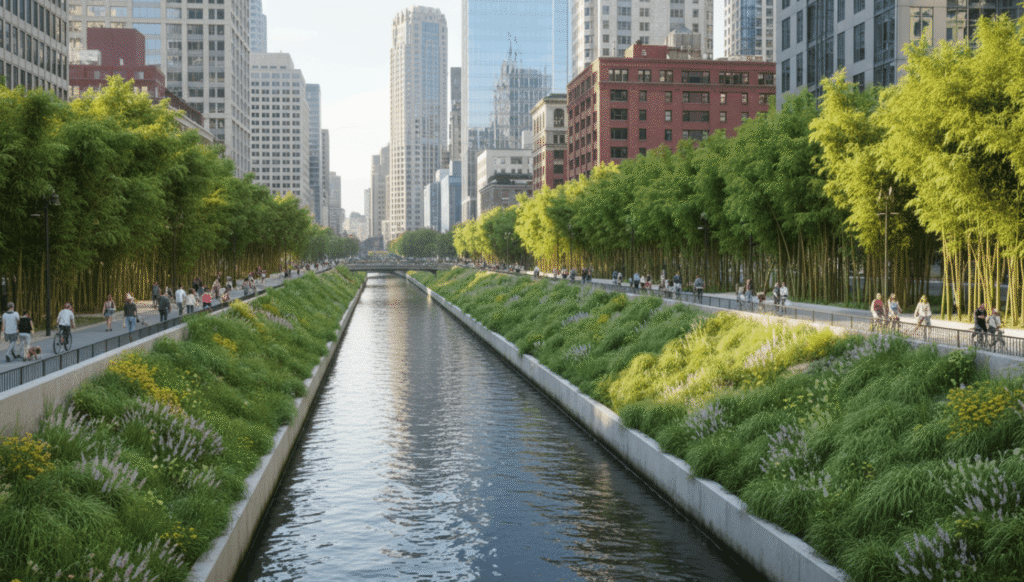
FOR example, instead of constructing purely gray dikes and levees for riverside protection, we can incorporate the use of bamboo and vetiver grass. Both bamboo (subfamily Bambusoideae) and vetiver (Chrysopogon Zizaniodies) had been showing remarkable protective and mitigating benefits. Bamboo is demonstrating its ability in local water cycle regulation and, therefore, effective for runoff retention, soil consolidation, and stabilization (as cited in Tardio, G. et al., 2018) [6].
Conceptual image created through MuselyAi
WITH the use of the most suitable species and combined with other mitigating systems, bamboos could help prevent erosion and reduce infiltration of flood water. Vetiver, meanwhile, is already being used as part of NbS in flood control mostly because of its root system. Its roots can grow up to 3 to 4 meters deep, allowing it to hold the soil firmly helping prevent landslides [7]. When applied as dense hedges–for example, alongside dikes–the grasses serve as natural barrier [8]. If designed well, and possibly together with bamboos, the system could help slow down or even decrease water runoff. In the conceptual illustration above–which I have developed with the use of MuselyAi–integrating the use of vegetation such as bamboo and vetiver in gray infrastructure in riverbanks (alongside other programs such as massive tree planting) could likely minimize if not prevent flooding. I have not personally tested this method /system but a quick online search revealed that the bamboo-vetiver combination is already being done in a WWF project in Nepal [9]. Dr. Paul Truong (1999) has studied the application of vetiver in flood and stream bank erosion control in several case studies and the positive impact is indeed remarkable [10]. Below–a quoted material from his work–demonstrates the effectiveness of vetiver grass technology (VGT) in flood protection:
“In Australia, field trials using hydraulic characteristics determined by the above tests showed that vetiver hedges were successful in protecting agricultural lands from flood damage.
VGT has been used as an alternative to strip cropping practice on the flood plain of Queensland. This practice relies on the stubble of previous crops for erosion control of fallow land and young crops. On this experimental site, vetiver hedges that were established at 90m interval provided a permanent protection against flooded water. Following several major flood events VGT has shown to be very successful in reducing flood velocity and limiting soil movement, with very little erosion in fallow strips. Furthermore, a young sorghum crop was completely protected from flood damage thanks to VGT.
The incorporation of vetiver hedges as an alternative to strip cropping on floodplains has resulted in more flexibility, more easily managed land and more effective spreading of flood flows in drought years and with low stubble producing crops. An added benefit is that the area cropped at any one time could be increased by up to 30%” (Truong, 1999).
[3] IMPLEMENTING No Build Zone policies strictly. In the devastation of Tino’s floods, we have, once again, seen how poorly many LGUs are performing when it comes to compliance with No Build Zone policies. The Philippines has been achieving milestones in its zoning, governance, and environmental policy making but, clearly, implementation has a lot of room to grow. When it comes to zoning and building regulations, the following are just some of the relevant regulations:
o Philippine Disaster Risk Reduction and Management Act of 2010 (RA 10121)
o Comprehensive Land Use Plans as mandated by the Local Government Code (RA 7160)
o Relevant LGU zoning ordinances
o Local Government Code (RA 7160)
o The Water Code of the Philippines (Presidential Decree No. 1067)
o The National Building Code of the Philippines (PD No. 1096)
o Philippine Clean Water Act (RA 9275)
o Environmental Impact Statement (EIS) System (PD No. 1586)
o National Integrated Protected Areas System (NIPAS) Act (RA 7586, as amended by RA 11038)
o Other relevant LGU ordinances
o Other DENR Administrative Orders and Circulars
LGUs don’t deserve all the blame because it is indeed difficult to implement No Build Zone policies if people themselves have no other place where to build their houses. It’s a complicated issue and requires long-term solutions. However, the necessary steps can already be undertaken–such as the decongesting of highly-urbanized cities by creating and enhancing industries and opportunities in rural areas. Again, this is easier said than done but with strategic synergy between the government and the private sector–which requires political will–it is possible to reform cities and create more sustainable and resilient communities–both in urban and rural areas.
ENCOURAGING people to move to or stay in rural areas through better opportunities should also be undertaken with more care and mindfulness or we will simply be creating more unsustainable and fragile cities–if not done well, the same cycle will likely keep on repeating. A good starting point will always be with the LGUs. I have long been an advocate of decentralization. Growing and compounding climate-related challenges all the more require a closer look into how the Philippines can further build the capacities of LGUs while increasing private sector engagement.
[4] REQUIRING LGUs to provide in-city dwelling. Given the right support including financing, LGUs particularly in highly-urbanized and emerging cities should be required to build in-city dwelling for its workers particularly those living in high-risk zones such as riverbanks. Many will argue that there is already a shortage of land for public housing in cities but there are still areas that can accommodate such buildings. In Metro Manila, cities like Quezon City, Manila, San Juan and Caloocan have ongoing in-city housing projects [11].
THE task is gargantuan. Estimates vary but the project, Informal City Dialogues, placed the number of dwellers in slum areas in Metro Manila at around 1.6 million [12]. Meanwhile, the Borgen Project estimates it at 3 million (including the homeless) [13]. Assuming each household has 5 members, the higher estimate (which is likely the more realistic one) requires 600,000 housing units. If we divide this by 17 (Metro Manila has 16 cities and 1 town), each LGU needs to build 35,294 housing units. This may require each LGU to build 117 buildings (assuming 300 units per building). This will require about 23 terms, assuming each LGU will be able to build 5 buildings for every chief executive’s term (of three years). This will then translate to about 69 years of work! (And this is assuming that population will not significantly increase.) Therefore, while it is necessary to build in-city dwelling, it is still necessary to build industries in the countryside. It is not an either-or situation. We need to do both.
MOREOVER, in-city dwelling will ultimately become a circuitous cycle if the larger ‘evil’ (rural-to-urban migration) is not resolved. We need more decent jobs in the countryside. We need more industries. Most of all, we need to continue being inspired about building communities where everyone experiences genuine inclusion.
IT is my hope that this piece inspires you to become a change agent of not only resilience but also of empowerment and inclusion. Indeed, we build the government that we deserve. We carry a part of the responsibility. We are accountable, too. We are also partly to be blamed for Tino’s floods and the other floods in the past and many more in the future if we do not act together now. Let’s all do our part. Please engage with your local officials and concerned government agencies. Please participate in governance more actively. Once again, remember your great power. We need to hold the government more accountable but that also, we need to vote more wisely and carefully. That is also where our true power resides.
WE will do better because we all deserve better.
[For the 1st part of this piece, please go here.]
REFERENCES
[1] Asadian, Y. & Weiler, M. (2009.) A New Approach in Measuring Rainfall Interception by Urban Trees in Coastal British Columbia. Water Quality Research Journal, 44 (1),16–25. https://doi.org/10.2166/wqrj.2009.003
[2] A. Guevara-Escobar, A, González-Sosa, E., Véliz-Chávez, C., Ventura-Ramos, E., & Ramos-Salinas, M. (2007). Rainfall interception and distribution patterns of gross precipitation around an isolated Ficus benjamina tree in an urban area. Journal of Hydrology, 333(2-4), 532-541. https://doi.org/10.1016/j.jhydrol.2006.09.017
[3] Implementing Rules and Regulations (IRR) of RA 10176 otherwise known as the Arbor Day Act of 2012.
https://app.legaldex.com/laws/implementing-rules-and-regulations-irr-of-ra-10176-otherwise-known
[4] Aurelio, J. (2023). Mandatory tree planting for graduating students.
https://newsinfo.inquirer.net/1874502/mandatory-tree-planting-for-graduating-students
[5] Penchev, P. (2025). Urban Nature-Based Solutions for Flood Risk Mitigation. World Wildlife Fund.
https://wwfcee.org/pdf_collections/70/WWF_NBS%20Report_A4.pdf
[6] Stokes A., Sotir R., Chen W., Ghestem M. (2010). Soil bio-and eco-engineering in China: Past experience and future priorities. Journal of Ecological Engineering, 36(3), 247-257. https://doi.org/10.1016/j.ecoleng.2009.07.008
[7], [8] Tunapuna/Piarco Regional Corporation. (2025). Vetiver Vision, Mitigating Floods and Landslides in the Region. https://tprc.gov.tt/wp-content/uploads/2025/05/Vetiver-Flood-Mitigation-And-Landslide-Project.pdf
[9] WWF-Nepal (2025). Mitigating flood impacts with nature-based solutions in Nepal’s Kamdi Corridor. https://wwfclimatecrowd.org/project/mitigating-flood-impacts-with-nature-based-solutions-in-nepals-kamdi-corridor/
[10] Truong, P. (1999). Vetiver Grass Technology for Flood and Stream Bank Erosion Control. https://www.vetiver.org/CHN_VGT%20Flood.htm
[11] Philippine News Agency. (2025). DHSUD expediting 4PH projects in Metro Manila.
https://www.pna.gov.ph/articles/1248336
[12] Romero, P. (n.d.). Manila, Philippines. Informal City Dialogues. https://nextcity.org/informalcity/city/manila
[13] Johnson, A. (2024). Informal settlements and Slum Upgrading in the Philippines. The Borgen Project. https://borgenproject.org/informal-settlements/. https://borgenproject.org/informal-settlements/
Mama Earth loves you: To maintain independence, this website is self-funded and this write-up is not a commissioned work. There is no request for donation but if you can plant a tree (or two!) on your birthdays, it will really be awesome and will make Mama Earth very happy! P.s. It’s better if you could join the You’ve Got TREE-mail! Chain.


Leave a Reply