


MBA Renewables: A much-awaited online degree program!
Yes, you are reading it correctly! I am happy to find out that a university in Berlin, Germany, is now offering an online graduate program with focus on renewable energy. I have been waiting for this for the longest time now!

The course is called Master in Business Administration (MBA) Renewables, and is offered by the Institute for Distance Learning of the Beuth University of Applied Sciences Berlin (BUASB) in cooperation with the university’s Department of Business Administration and Social Sciences and the Renewables Academy AG (RENAC). The first run of the program will begin in October 2011. The course is spread over five terms (semesters) or 30 months. What makes this program unique is that it is the first-ever and only distance learning (online) MBA program with focus on renewable energy and energy efficiency.
This is very ideal for working professionals who have limited flexibility in terms of time and mobility. The Beuth University and RENAC are also known for their cutting-edge approaches in training environmental and energy students and professionals.
Personally, I preferred enrolling again in my alma mater, the University of the Philippines. In fact, I have already been admitted to the UP Open University’s Master in Environmental and Natural Resources Management (MENRM). However, I was recently told–with all due respect, albeit the one year of waiting for a reply–that it takes a long time to develop and then approve a new track (I requested for a customized track on climate change and renewable energy). The UPOU’s MENRM is still a good option for those wanting to concentrate in coastal and upland resources management but MBA Renewables may be a better program for those who are really keen on and passionate about more environmentally-friendly energy sourcing. It may also be another course offering that UPOU may want to consider in the future particularly that the Berlin program–while comprehensive and timely–may be considered quite expensive by students from countries such as the Philippines. [Update: I decided to go back to my alma mater, UP, and completed my MENRM degree in 2018. While I got accepted to the MBA renewables program, it was challenging to pursue it without a scholarship. I was working then and the schedule and matriculation in UP were more manageable. No regrets! My interest in RE remains and there are more online courses these days. I will still recommend MBA Renewables for those who are keen to pursue this career path and prefer an MBA approach.]
My interest in renewable energy is deeply-rooted because I have grown up vacationing in Aurora (my Mom’s hometown) where many barangays were not yet connected to the electricity grid back when I was still in high school and college. While many barangays there now are electrified, many lands/farms are still far from the main grid. More importantly, I have always believed that the renewable path is the way to go especially with the high cost of electricity in the Philippines.
We already know that the over-dependence on fossil fuels is the main culprit for greenhouse gases emissions in the atmosphere. For centuries now, economies are greatly-dependent on fossil fuels and related sources. Just in the year 2001, the world depended on oil and coal for roughly 58.4% of its energy requirements while only 13.5% were sourced from renewable energies.
Just in our neighborhood, we have experienced a very destructive flood brought by Typhoon Ondoy (Ketsana) last 2009. More than 1.8 million people were said to be affected. The damage to crops and properties was pegged at more than 5 billion pesos (roughly 107 million US dollars). Obviously, the issue on climate change has to be addressed more seriously. Stronger and more destructive typhoons and floods will continue to happen.
As such, countries should work together and focus more on climate adaptation, mitigation, and resilience. Low-carbon pathways to development and more use of renewable energy are critical. Environmental and social development professionals should continuously pass on the word and nurture future leaders. They should also be actively engaged in advocacy and policy work for a more serious shift in energy sourcing (at the minimum, increasing the share of RE in the energy mix).
In the Philippines, we have already enacted the Republic Act 9513 or An Act Promoting the Development, Utilization, and Commercialization of Renewable Energy Sources and for Other Purposes–but we need to do more in improving the markets. The role of the market cannot be over-emphasized. Issues such as on trading, financing and investments, transmission and grid connections, market regulatory policies, and pricing should be resolved, and soon.
Education and training programs like MBA Renewables is a step in the right direction.
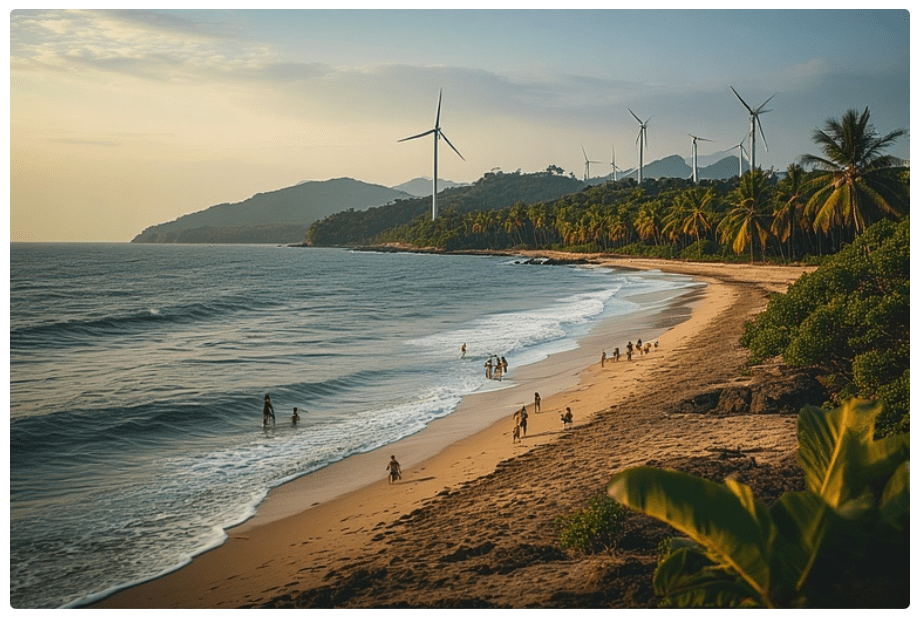
Conceptual image (left) created thru Perchance.
Kudos and many thanks to those who developed the Program! Special thanks also goes to Ms. Silja Kroesche, Program Coordinator, for her patience in answering my emails!
Mama Earth loves you: To maintain independence, this website is self-funded and this write-up is not a commissioned work. There is no request for donation but if you can plant a tree (or two!) on your birthdays, it will really be awesome and will make Mama Earth very happy!


Pingback: Be fired up for the job « meiLBOX