

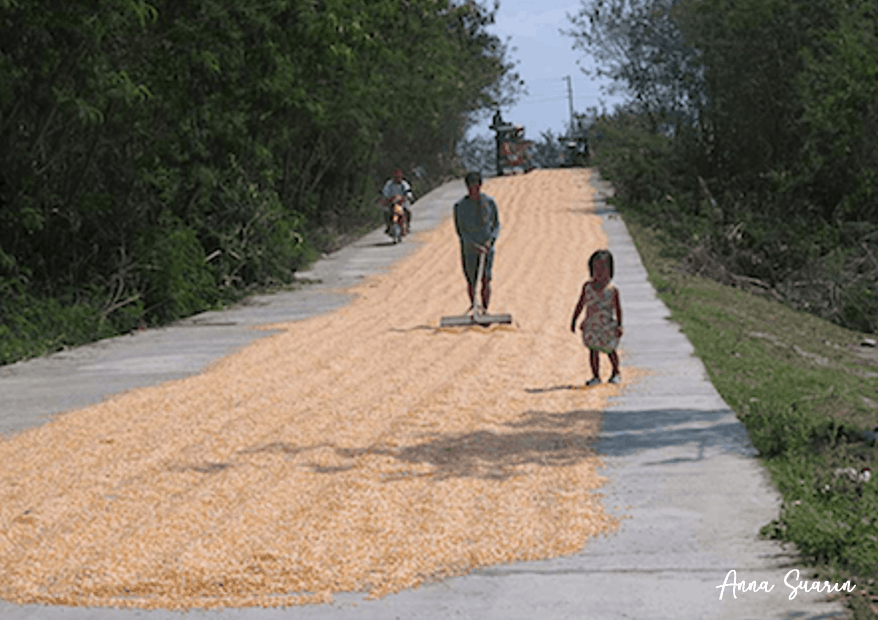
A sustainable future is not possible if those who put food on the table are still among the poorest
How an ecosystem- and spatial-based approach to development and the optimization of the blue economy can empower farmers and fisherfolks
In our next meal, it’s time that we think about more seriously about those who put food on the table.
The Philippines is indeed a ‘rich’ country—blessed with immeasurable natural resources—where no one is supposed to be hungry. Our fertile soil and vast oceans replete with fishes and other marine resources could well be worth more than USD 7 trillion [1]. The blue economy’s intrinsic value (marine ecosystem goods and services) alone is about USD 6 trillion (Azanza et al., 2022) [2]. Using today’s forex (USD1 = PhP 61.63, updated 17 May 2026), this is equivalent to about PhP 438 trillion-worth of natural assets. In practical terms, the PhP 438 trillion could finance around 22 years of government spending under reasonable economic assumptions. [3]
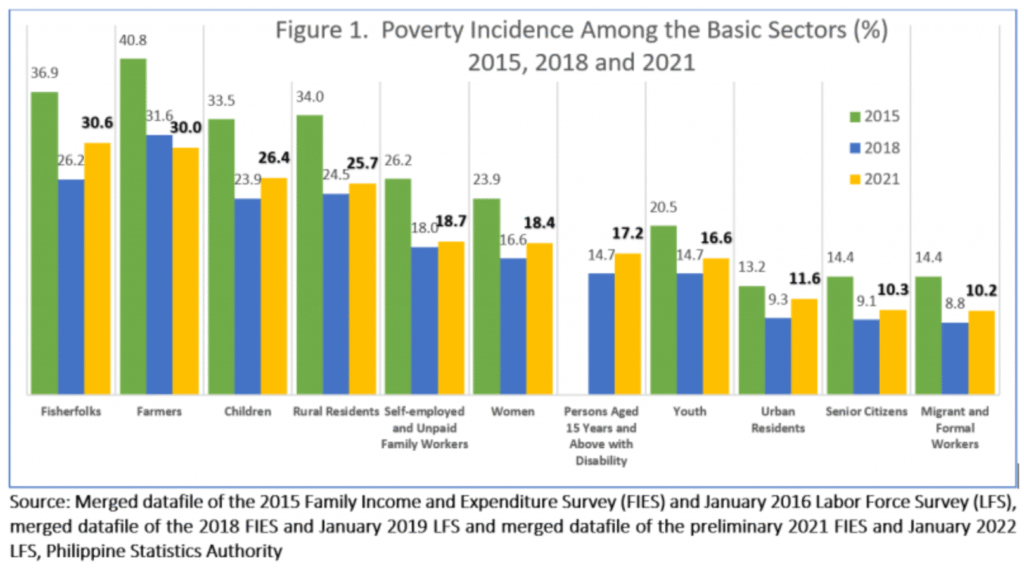
Therefore, easily, a country with such vast of resources (assuming they are managed in the most sustainable manner) should no longer have many of their farmers and fisherfolks living in poverty. However, in the Philippines, the numbers are glaring. For a country with such vast of natural wealth, many farmers and fisherfolks—those who put the food on the table—are the same ones who could not even afford to eat three square meals a day! Based on the latest official data (PSA, 2025), fisherfolks (30.6%) and farmers (30%) remain among the poorest in the basic sectors in terms of poverty incidence in 2021 [Figure 1]. The magnitude is significant. The PSA source did not indicate the actual numbers of poor farmers and fisher folks but the current estimate is at 2.7 million (Custodio & Sombilla, 2023). [4]
How can a country so rich in natural resources still have many of its farmers and fisherfolks living in poverty?
This has to change. In the age of internet, AI, and robotics, it is no longer just that those who toil under the sweltering heat and high-risk conditions in seas and oceans—so that we can all eat—are not receiving their just share in the nation’s wealth.
Note on Figure 1 data: Basic sectors are not mutually exclusive. This means that there are overlaps in the estimates in the sectors. For example, women may also be counted as senior citizens, farmers, etc. [Source of graph on the left: PSA, 2025]
Indeed, numbers don’t lie. What are the core reasons behind these unfortunate numbers? Why are our farmers and fisherfolks still poor? The roots and causes are quite complex. However, at the core of the complexities is the underperformance of the agriculture and fisheries sectors. What are the reasons for the underperformance? Answers are complex and have already been investigated many times over. This piece does not aim to make an exhaustive analysis. Instead, it will focus on offering a transformative pathway through which the sector—and practically, the whole country—can frame, plan for, and undertake its development. This proposes an ecosystem- and spatial-based approach to development while also fully optimizing the potential of the blue economy.
Before tackling the recommended pathway, this briefly shares some of the reasons for the underperformance of the agriculture and fisheries sector. There is no attempt to reinvent the wheel; the causes shared here are from existing studies and from a work that I (along with a TA team) have undertaken for the Asian Development Bank in 2023. The underperformance of the Philippine agriculture sector is mainly rooted in the following reasons: (i) shrinking farm size and land fragmentation; (ii) underperforming irrigation infrastructure; (iii) weak decentralization; (iv) open-access overfishing and fisheries collapse; (v) weak value chains and high post-harvest losses; (vi) climate vulnerability; (vii) trade liberalization; and (viii) low access to and mismatched knowledge assets, ICT, and financing. These are briefly explained below.
[This is a work-in-progress. Please visit again soon.]
Notes and references:
[1] It is difficult to derive a more robust estimate due to lack of data. This estimate is derived by adding figures from best-available monetary values for land-based resource categories with mining resources estimated at US$ 1 trillion (Vantage FDI, 2025), and then adding the estimated US$ 6 trillion value of the blue economy (Azanza et al., 2022). All values are from official government data, peer-reviewed studies, or recognized industry reports. The result is a conservative, directional total, as it combines annual flow values (forestry, agriculture, ecosystem services, tourism, industrial land rentals) with stock values (e.g., minerals and real-estate land).
[2] Azanza, R. V., Sanchez-Escalona, K., & Largo, D. B. (2022). A sustainable and inclusive blue economy for the Philippine archipelago. Transactions NAST PHL, 44. https://doi.org/10.57043/transnastphl.2022.2564
[3] To project future budgets, a nominal annual increase of 10% is applied. This rate aligns with the Philippines’ medium-term macroeconomic outlook, for exampe, based on (i) real GDP growth of 6-7% (International Monetary Fund, 2025); (ii) inflation averaging 3-4% (Bangko Sentral ng Pilipinas, 2025); (iii) historical national budget growth of about 10% per year over the last decade (DBM, 2025).
[4] Custodio, K. Q., & Sombilla, M. A. (2023). Rural transformation in the Philippines: A development agenda (Policy Papers Vol. 2023 No. 1). SEARCA. https://www.searca.org/pubs/briefs-notes?pid=565
Mama Earth loves you: To maintain independence, this website is self-funded and this write-up is not a commissioned work. There is no request for donation but if you can plant a tree (or two!) on your birthdays, it will really be awesome and will make Mama Earth very happy! P.s. It’s better if you could join the You’ve Got TREE-mail! Chain.

Leave a Reply